The Killary Flood
Dark Lies the IslandThe Killary Flood is the rising-water emergency that isolates the Water’s Edge Hotel and its occupants from the surrounding area. Its decisive turn is the loss of ordinary escape: the road between the hotel and harbour disappears, water crosses the porch and enters the building, and the group must move to an upstairs function room. As the flood intensifies, the hotel becomes both a precarious refuge and an improvised community space, where calls for help, local knowledge, and hospitality contend with the uncertainty of rescue.
Warning Signs and Isolation
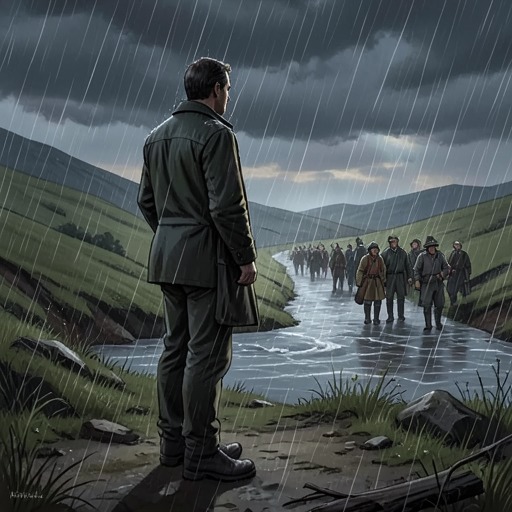
The flood announces itself through changes at the edge of the hotel’s familiar landscape. Dogs howl across the hillsides in a sequence that grows too loud to ignore. When people go to the windows, the roadway between the hotel and the harbour wall has already disappeared; the remaining evening light has an unnatural green cast, and rain continues. The water reaches the second of the four stone steps leading to the front porch, and the hotel’s occupants recognize that it is still rising.
An otter appears inside the kitchen while the hotel’s proprietor is eating soup. Rather than head towards the tide-line rocks where otters lived, it moves towards higher ground to the south. The animal’s unexpected route gives the flood’s danger a measure that observation of the harbour alone cannot provide: water is displacing wildlife from its usual setting too. Outside, the threat is not only a sudden rise in water but a landscape whose ordinary boundaries and routes are ceasing to hold.
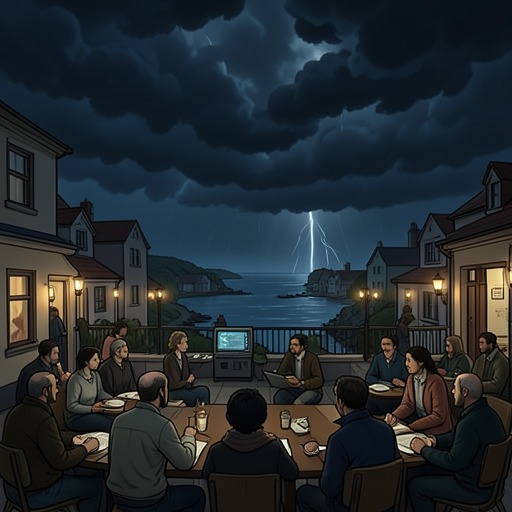
The group withdraws from the windows. Mobile calls are made quietly, and people begin speaking in whispers. News travels along the fjord that the water has risen and breached the harbour walls; emergency services have been alerted, while discussion of sandbags comes late. Six of the nine Belarusians join the people already in the lounge bar. The other three are away at a cinema in Westport, where they have gone to see a Dan Brown adaptation. The hotel proprietor offers a round of drinks, acknowledging that they may be stuck there for some time. Applause follows, and the bar takes on a temporary conviviality shaped by the shared threat.
From Rising Water to Flooded Hotel
At first, the flooding appears to be confined to the immediate area. The car park beside the hotel is reported to be completely submerged, and the water passes the fourth porch step before sweeping over the porch itself. Across the harbour, lights remain visible on the mountainside of Mweelrea until they suddenly go out. The apparent local reach of the emergency sharpens the occupants’ isolation: the rest of the country is continuing with an ordinary Monday evening, while the people around the hotel face the prospect of being cut off by the water.
The Belarusians carry boxes of old curtains down from the attic to block the doorways. Their effort cannot hold the water back: as soon as the last box reaches the bottom of the stairs, the doors give way and the flood enters. The attempted barrier marks a transition from preparing against inundation to responding to it inside the building. The hotel is no longer simply threatened from outside; its lower level has become unsafe.
The proprietor moves everyone upstairs to the function room used for occasional weddings. It has a fully stocked bar and working disco lights, and the group reaches it in time. Looking back down the stairs, the proprietor sees the flooded exterior as a scene of mortal danger, then urges people onwards. Emergency services are said to be moving out, but the occupants must act before outside help arrives. The change of floor changes the hotel’s purpose: a room intended for celebrations becomes the group’s temporary refuge.
Collective Response and Uncertainty
The response combines practical coordination with the routines of hospitality. People make further mobile calls, and the proprietor switches off the harsh strip lighting in favor of the room’s moving mood lights, opens the bar, and serves the locals who come forward. The drinks do not solve the danger, but the familiar social setting helps give the stranded group a way to remain together as the hotel is surrounded. Earlier, a glance outside had revealed a black-backed gull apparently feeding on its dead mate; the proprietor keeps the sight private, an instance of how the crisis produces disturbing observations that are not all shared with the group.
The animals in the flood narrative do not all behave as emblems or warnings. The otter leaves its normal habitat for higher ground, while the dogs’ repeated howling accompanies the loss of the road and the rise of the water. Later, seven sheep are seen bobbing in a rowing boat on the floodwaters, strangely calm. Their presence makes the inundation a shared disturbance of human and animal space, even as each animal’s behavior remains distinct: flight towards higher ground, alarm, or apparent composure.
The occupants’ expectation of rescue does not immediately become a way out. Mobile signals fail, no rescue workers appear on the horizon, and the water continues to rise. These details leave the hotel community suspended between the emergency services’ promised response and the flood’s continued advance. The hotel proprietor’s earlier offer of drinks, the group’s movement upstairs, and the use of the function room are therefore not signs that the danger has passed; they are ways of coping while its outcome remains uncertain.
Consequences and Narrative Significance
The flood’s effects reach beyond the hotel. In a separate episode, two women fleeing after an attempted child abduction drive at speeds twenty to thirty and then forty kilometres above the limit through Sligo, Leitrim, and Cavan. They use the crossing into Northern Ireland as a practical means of escape, waiting until they cross the bridge between Blacklion and Belcoo before speaking again. This later account gives the flood’s wider geography a different consequence: once regional movement is shaped by crisis, roads, borders, and jurisdiction become part of how people seek safety.
The narrative also sets the hotel’s sudden isolation beside other forms of precarious shelter and confinement. In Llandudno, families endure punishing heat during a Real Ale Club outing; in Leytonstone, a young man shares a house with three heavy-drinking housemates while living through obsessive longing and bleak weekends. Elsewhere, an old caravan has a broken lock and a chained door, and its captive escapes by lifting a loose piece of plywood beneath a chemical toilet and crawling under the vehicle. These episodes are not consequences of the Killary Flood, but they echo its concern with the conditions that make shelter either refuge or trap: access, boundaries, weather, and the ability to leave.
At the hotel, the immediate sequence moves from warning signs to inundation, evacuation upstairs, and the loss of reliable communication, without supplying a definitive rescue or a final account of the flood’s damage. Its force lies partly in that unresolved interval. Familiar infrastructure—the road, harbour wall, porch, and mobile signal—fails in succession, while the hotel’s bar and function room are repurposed to sustain a group whose safety is not assured. The crisis turns a private building into an improvised shelter and makes the boundary between ordinary local life and disaster impossible to maintain.